

You’ve Been Clickbaited — Now Let’s Talk About the Facts
If one of our outrageous social-media videos brought you here, congratulations: you’ve been clickbaited. No, UPLA didn’t buy 50,000 acres of Grand Staircase-Escalante. No, three million acres of Utah didn’t disappear. No, a mining company can’t file a claim today and have an open-pit mine operating by lunch. And no, rescinding the Roadless Rule doesn’t mean 45 million acres of National Forest will be paved by morning.
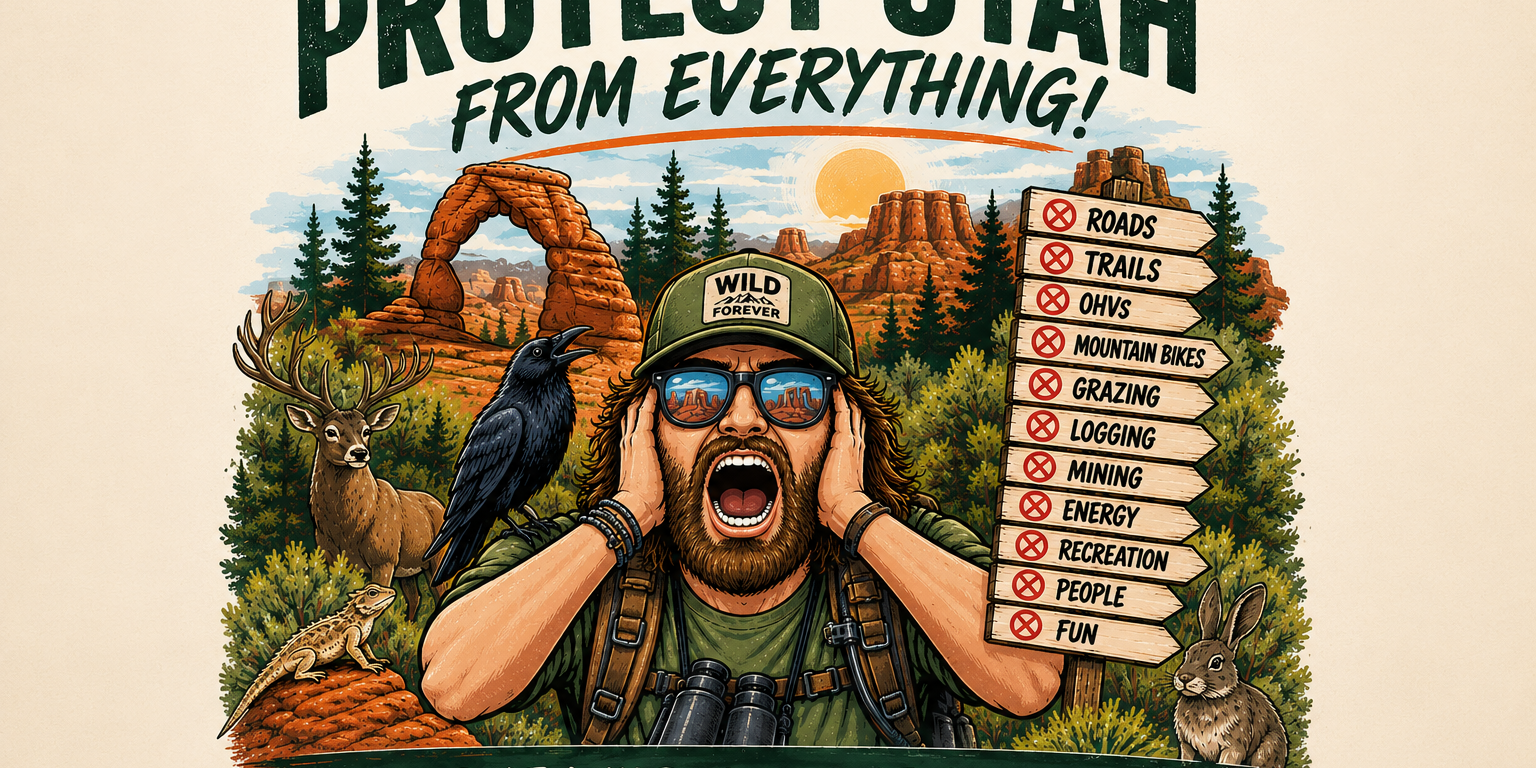
We made those headlines up. Why? Because public-lands advocacy has become increasingly dominated by frightening headlines, carefully selected words and claims designed to make you react before you have time to ask a simple question: What actually happened?
We’re going to have some fun with that, but we’re also going to show you the facts and let you decide for yourself.
“TRUMP OBLITERATES 3 MILLION ACRES OF UTAH — SATELLITES CONFIRM LAND HAS DISAPPEARED”
Okay, we made up the satellite part. But compare our ridiculous headline with some of the actual rhetoric surrounding the 2026 reductions of Bears Ears and Grand Staircase-Escalante National Monuments. The Southern Utah Wilderness Alliance described the July 13 action as part of an effort to “dismantle and obliterate America’s system of public lands.”
Those are powerful words. But reducing a national monument does not make the public land disappear. Land removed from a national monument boundary does not automatically become private property. It remains federal public land unless it is separately disposed of under applicable law.
You can support the monument reductions or oppose them, but let’s debate what actually happened. The monument designation changed. The public land didn’t disappear.
UPLA has written extensively about exactly what changed—and what didn’t—in the 2026 monument proclamations.
Learn more: FACT CHECK: Separating Fact from Fiction About the Grand Staircase National Monument Changes
More background: Beyond the Memes — Why UPLA Made Monument Reform a Top Priority
“BLM REMOVES MONUMENT SIGN — ENTIRE MONUMENT IMMEDIATELY CEASES TO EXIST”
This one isn’t entirely random. SUWA has used words like “erase,” “destroy,” “obliterate” and “decimate” to describe monument changes and related federal actions.
Removing a sign doesn’t erase the land, and changing a monument boundary doesn’t erase the land either. What changes is the legal designation and management framework governing the affected acreage. That distinction gets lost pretty quickly when emotional language becomes the headline.
UPLA’s position has never been that the resources deserving protection should simply be abandoned. We have argued that important archaeological, historical, cultural and scientific resources can be protected without placing millions of surrounding acres under monument restrictions.
Learn more: Two Years of UPLA Advocacy Helped Shape a New Direction for Utah’s Public Lands
“UPLA BUYS 50,000 ACRES OF GRAND STAIRCASE — MASSIVE OHV PARK OPENS SATURDAY”
We admit it. This one is completely made up.
UPLA didn’t buy 50,000 acres. We don’t own Grand Staircase. And we’re not opening the UPLA Grand Staircase OHV Superpark this Saturday.
But there is a serious point behind the joke. National monument reductions are often described in ways that leave people believing public lands are being privatized or sold. Changing the boundary of a national monument and selling federal land are two entirely different government actions.
The 2026 proclamations did not transfer a single acre of the excluded lands to UPLA, the State of Utah, a developer, a mining company or anyone else.
National monument status is not the same thing as public ownership.
UPLA’s detailed fact check addresses this issue directly.
Read the fact check: Separating Fact from Fiction About the Grand Staircase National Monument Changes
“MINING CLAIM FILED IN UTAH — OPEN-PIT MINE EXPECTED TO BE OPERATING BY LUNCH”
This parody practically wrote itself.
Recent mining claims on lands affected by the monument reductions generated alarming headlines. But filing a mining claim is not the same thing as receiving permission to immediately construct and operate a mine.
Mining proposals can still involve federal land-management requirements, permitting, environmental review, cultural-resource protections and other applicable laws.
There are legitimate questions about future mineral development on these lands. Those questions deserve serious consideration. But a claim on a map doesn’t mean someone starts digging a giant hole tomorrow.
Mining claim does not equal operating mine.
For a broader explanation of what the Grand Staircase proclamation actually did, see UPLA’s Grand Staircase Fact Check.
“MINING COMPANY FILES 7 CLAIMS — ENVIRONMENTAL REVIEW, PERMITTING AND FEDERAL LAW IMMEDIATELY CANCELLED”
No. Removing land from a national monument doesn’t magically erase the rest of federal law.
There are legitimate questions about what mineral development may eventually be permitted on these lands, but that discussion should be based on what the law actually allows, not on the assumption that every other protection has disappeared.
Monument designation is one layer of federal land management. It is not the entirety of federal environmental and cultural-resource law.
Learn more about UPLA’s monument position: Beyond the Memes — Why UPLA Made Monument Reform a Top Priority
“NATIONAL MONUMENT REDUCED — PUBLIC LAND AUTOMATICALLY SOLD TO DEVELOPERS”
No sale. No developer. No moving trucks.
The land remains public land.
A national monument is a federal land designation. It is not synonymous with federal ownership itself. Americans should be able to debate whether a particular landscape deserves monument designation without being told that the only alternative is selling the land.
UPLA specifically addressed this misconception after the July proclamations: changing a monument boundary is not a change in ownership.
Read more: FACT CHECK: Separating Fact from Fiction About the Grand Staircase National Monument Changes
“MONUMENT BOUNDARY MOVES — BLM EMPLOYEES DISCOVER THEY NO LONGER MANAGE BLM LAND”
Fortunately, BLM found it again.
The federal government manages enormous amounts of public land that aren’t inside national monuments. Those lands don’t cease being public simply because they aren’t part of a monument.
The real question is not simply “protected or unprotected?”
The better question is: Under which laws and management framework should this public land be managed?
That doesn’t make as good a social-media headline, but it is a much more useful conversation.
For more about UPLA’s position on returning excluded monument lands to multiple-use management, read Two Years of UPLA Advocacy Helped Shape a New Direction for Utah’s Public Lands.
“ROADLESS RULE RESCINDED — 45 MILLION ACRES OF NATIONAL FOREST PAVED BY MORNING”
Better leave early. That’s a lot of asphalt.
Opponents of rescinding the Roadless Rule emphasize the tens of millions of acres covered by the rule. But eliminating the Roadless Rule does not order the Forest Service to construct roads across every affected acre.
It changes a nationwide regulatory restriction affecting road construction, reconstruction and certain timber activities. Individual projects remain subject to other applicable planning, environmental and administrative requirements.
There is a legitimate policy debate here: should one nationwide rule impose these restrictions, or should individual national forests have greater ability to make management decisions based on local circumstances?
That’s the debate. “45 million acres paved by morning” isn’t.
UPLA submitted detailed comments supporting rescission of the Roadless Rule.
Read UPLA’s position and comments: Comments Needed for Rescission of Roadless Rule
“FOREST SERVICE CONSIDERS CHANGING OHV RULE — MILLIONS OF ACRES IMMEDIATELY OVERRUN BY UNMANAGED SIDE-BY-SIDES”
We exaggerated this one, but perhaps not by as much as you think.
Opponents have characterized proposed Forest Service travel-management changes as opening millions of acres to “unmanaged” off-road vehicles.
That’s advocacy. The actual process is more complicated.
A proposal to revise a regulation is not the same thing as opening millions of acres tomorrow. Rules must go through the applicable process, and individual travel-management and route-designation decisions still matter.
UPLA strongly supports reconsidering federal regulations that have unnecessarily restricted responsible motorized access.
But a proposed regulatory revision isn’t an open trail.
UPLA has been working on travel-management reform and individual TMPs for years. You can see an example of that work in our Trail Canyon and Dino North Travel Management Plan comments.
“FOREST SERVICE REVIEWS CLOSED ROADS — HIKERS ADVISED TO FLEE NATIONAL FORESTS IMMEDIATELY”
Don’t cancel your hiking trip.
The Forest Service is reconsidering significant portions of its approach to motorized travel management. UPLA believes this review is long overdue.
Thousands of roads and trails have been closed or restricted through decades of travel-management planning, and we believe agencies should be willing to revisit those decisions rather than assuming every closure should remain permanent forever.
Conditions change. Technology changes. Recreation changes. Management capabilities change. Public needs change.
Reviewing a closed route doesn’t automatically reopen it. It simply asks a question UPLA believes should have been asked much more often:
Does this closure still make sense today?
This is the same principle UPLA has advocated in Utah when previously closed routes have been reconsidered.
UPLA Hasn’t Written on This Yet, but BlueRibbon Coalition Covers It Here Forest Service Overhauls Travel Management Planning
“50-YEAR-OLD OHV EXECUTIVE ORDERS RESCINDED — CLEAN WATER AND WILDLIFE REPORTED MISSING”
They’re still there.
President Trump’s May 2026 action rescinding the decades-old OHV executive orders represented an enormous change in federal motorized recreation policy.
UPLA supported that change.
We believe it is appropriate to reconsider a regulatory framework that has repeatedly been used to restrict motorized access. But eliminating one regulatory framework does not eliminate every environmental law governing federal lands.
Clean water didn’t disappear. Wildlife didn’t disappear. Environmental laws didn’t disappear.
The rules governing how agencies balance those interests are changing. That’s the real story.
UPLA covered the executive action when it happened:
Read more: President Trump Signs Historic Executive Order Restoring OHV Access
“OHV MINIMIZATION CRITERIA RESCINDED — SIDE-BY-SIDES NOW LEGALLY PERMITTED INSIDE VISITOR CENTERS”
Please don’t.
Seriously.
Changes to the old OHV executive-order framework do not mean every square foot of federal land is suddenly open to motor vehicles. Existing route designations, closures, travel plans and other restrictions do not simply vanish overnight.
This is exactly why UPLA believes motorized recreationists need accurate information too.
Responsible access requires responsible users.
UPLA and BlueRibbon Coalition have spent considerable effort seeking reform of the federal minimization criteria, including petitioning for revision of 43 CFR § 8342.1.
Read the background: Help Us Rescind the Minimization Criteria
Read about the executive action: President Trump Signs Historic Executive Order Restoring OHV Access
“PUBLIC LAND RETURNED TO MULTIPLE USE — CONSERVATION OFFICIALLY BANNED”
This may be our favorite.
Some public-land rhetoric treats multiple use almost as if it were the opposite of conservation.
It isn’t.
Multiple-use management can include recreation, grazing, wildlife, watersheds, minerals, energy, timber, cultural resources and conservation. It does not mean every use occurs on every acre, and it does not mean environmental considerations disappear.
UPLA’s position is simple:
Conservation and access can coexist.
That principle has been central to our position on monument reform. We have consistently argued for protecting important resources while allowing surrounding public lands to remain available for responsible multiple use.
Read more: Beyond the Memes — Why UPLA Made Monument Reform a Top Priority
“GRAND STAIRCASE OPENED TO MULTIPLE USE — EVERY ACRE SIMULTANEOUSLY MINED, DRILLED, LOGGED AND DRIVEN OVER”
That would certainly make for an interesting Tuesday.
But that’s not what multiple use means.
Opening land to consideration for additional uses does not mean every possible use will occur. It means those uses may be considered under applicable laws, plans and regulatory processes.
A recreation area can remain recreation-oriented. Important cultural resources can still be protected. Wildlife can still be managed. Motorized access can exist without converting the landscape into an industrial wasteland.
Multiple use isn’t maximum use.
For a deeper explanation of what actually changed at Grand Staircase-Escalante, see UPLA’s Grand Staircase Fact Check.
“NATIONAL MONUMENT REDUCED — 100,000 ARCHAEOLOGICAL SITES IMMEDIATELY LOSE ALL FEDERAL PROTECTION”
No.
UPLA recognizes the importance of protecting archaeological, historical and cultural resources at Bears Ears and throughout Utah.
But national monument designation is not the only federal protection for archaeological resources. Reducing a monument does not suddenly make archaeological vandalism legal, authorize looting or repeal federal cultural-resource laws.
We can debate how these lands should be managed without pretending that reducing a monument creates an archaeological free-for-all.
In fact, UPLA’s monument advocacy has consistently argued that important resources should remain protected while access and multiple use are restored where appropriate.
Read more: Beyond the Memes — Why UPLA Made Monument Reform a Top Priority
For those who want to dig into the actual Bears Ears planning documents, UPLA also maintains its Bears Ears National Monument RMP Resource Center.
“EXECUTIVE ORDER EVICTS TRIBAL NATIONS FROM BEARS EARS — TRIBAL MEMBERS MUST VACATE MONUMENT BY FRIDAY”
No. Nobody is being evicted from Bears Ears. In fact, everyone is now welcome to enjoy this beautiful landscape.
The 2026 Bears Ears proclamation did make a significant change to the formal Tribal role in monument management by replacing the Bears Ears Commission with a new Monument Advisory Committee.
The Tribal Councils have a front row seat at the table, but they are now joined with state and local government in determining the plans for the area.
The new advisory structure includes representatives of the federally recognized Tribes with historical ties to Bears Ears. UPLA discussed that change—and the broader management changes contained in the proclamation—when it was announced.
Read more: Two Years of UPLA Advocacy Helped Shape a New Direction for Utah’s Public Lands
UPLA also maintains extensive background material on the previous Bears Ears management structure in our Bears Ears RMP Resource Center.
“NEW FEDERAL RULE BANS BAREFOOT TRAVEL ON PUBLIC LANDS — APPROVED FOOTWEAR REQUIRED”
We made this one up too.
Completely.
There is no new federal rule banning barefoot travel on public lands. No federally approved hiking-shoe list. No BLM footwear inspection station.
And, as far as we know, Crocs are still a personal decision.
Why include something this ridiculous?
Because it makes the point.
Put “BREAKING,” “NEW FEDERAL RULE” and the name of a government agency in front of almost anything and there’s a good chance somebody will share it before checking whether it’s true.
This one has no UPLA background article to link to because—again—we completely made it up.
Before you share it, get angry about it or organize against it, check whether the rule actually exists.
That’s exactly the habit this series is trying to encourage.
“SUWA ANNOUNCES PUBLIC LANDS DESTROYED FOR THIRD TIME THIS WEEK — BLM CONFIRMS THEY’RE STILL THERE”
Okay. We definitely made that one up too.
But it gets to the larger point.
SUWA, The Wilderness Society and other conservation organizations have every right to advocate passionately for their positions.
So does UPLA.
Advocacy, however, is not the same thing as objective description. That’s true when they do it, and it’s true when we do it.
That is why these reels are intentionally ridiculous. We want people to recognize how easily emotional language can take the place of understanding what the government actually did.
Words like destroy, erase, obliterate, decimate, chaos and exploit get attention. They are also very effective at shaping how people feel about an issue before they ever read the underlying document.
So yes, we’re going to have some fun with it.
But there is a serious message behind the parody.
Don’t just read the headline.
Read the proclamation. Read the executive order. Read the proposed regulation. Read the land-use plan. Read the environmental analysis. Read what SUWA and The Wilderness Society have to say. Read organizations that disagree with them too.
Then make up your own mind.
If you want to understand why UPLA has invested so much effort in reading thousands of pages of federal documents rather than simply reacting to social-media headlines, read Beyond the Memes — Why UPLA Made Monument Reform a Top Priority.
Our public lands deserve a debate based on facts rather than fear.
Read the Documents. Know the Facts.
Utah Public Lands Alliance believes responsible access and responsible stewardship can coexist. We advocate for public-land policies that recognize motorized recreation, multiple use, conservation, rural communities and meaningful public access.
And sometimes we’re going to use a little humor to make the point.
We Fight. We Win. We Ride.
We Give You the Facts. You Decide.
UPLA is committed to represent motorized off highway recreation first and foremost, but we also care deeply about the land in every respect. If you believe in us, please consider showing your support.