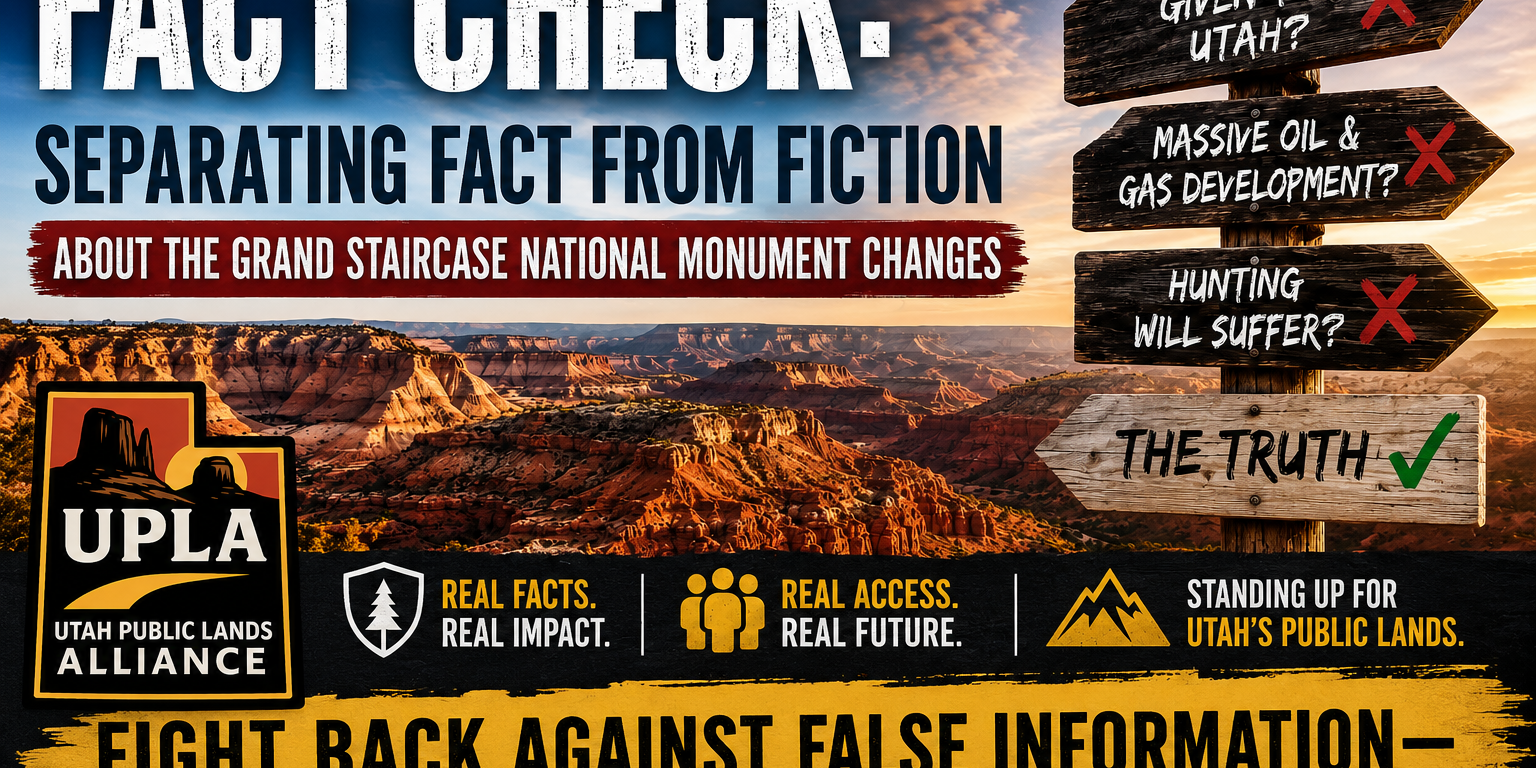


Since the new monument proclamations were issued, social media has been flooded with claims about what the changes will mean for Utah’s public lands. A few claims are partially accurate. Most are misleading or simply false. This article examines the most common claims against the language of the Presidential Proclamation, the Grand Staircase–Escalante Resource Management Plan, and existing federal law.
| FALSE | Claim #1: ‘Federal land was given to the State of Utah.’ |
One of the most common statements circulating on social media is that the recent monument proclamation ‘gave away federal land’ or transferred millions of acres to the State of Utah. That simply did not happen.
The proclamation modified the boundaries of the National Monument. It did not transfer ownership of a single acre. Every acre removed from the monument remains federal public land managed by the Bureau of Land Management. A National Monument designation changes how federal land is managed—not who owns it. Congress would have to enact separate legislation to transfer ownership.
Bottom Line: The management designation changed. Ownership did not.
| FALSE | Claim #2: ‘The President cannot modify the boundaries of a National Monument.’ |
This claim is contradicted by more than a century of presidential practice. Presidents from both political parties have modified National Monument boundaries dozens of times since the Antiquities Act was enacted in 1906. The Department of Justice issued a comprehensive legal opinion of the history of past modifications and The laconcluding that this authority exists, and Congress has repeatedly legislated against the backdrop of those modifications without prohibiting them.
Although opponents continue to challenge this authority in court, there is currently no judicial decision holding that Presidents lack the authority to modify monument boundaries. The current proclamations therefore remain legally effective.
Bottom Line: More than 100 years of presidential practice, supported by a formal Department of Justice opinion, demonstrates that Presidents have exercised this authority repeatedly. The current proclamations remain in full force unless a court rules otherwise.
| PARTIALLY FALSE | Claim #3: ‘There will be an explosion of oil, gas, and mineral development.’ |
The proclamation itself authorizes no drilling, mining, or leasing. It restores management of lands outside the revised monument boundaries to BLM’s multiple-use framework. Any future lease would require separate agency decisions, NEPA review, public comment, consultation, and compliance with numerous federal laws. Many federal leases are never developed.
Bottom Line: Future leasing may be considered, but nothing has been automatically approved.
| FALSE | Claim #4: ‘Hunting opportunities will be degraded.’ |
The proclamation specifically directs the Secretary of the Interior to improve public access, including for recreation and hunting. The Proclamation language specifically states “When preparing a management plan for the Monument, the Secretary shall take into account, to the maximum extent consistent with the proper care and management of the objects identified above, the importance of) improving public access, including for recreation and hunting.”
Many hunters rely on motorized access to reach trailheads and retrieve game. The current Proclamation only strengthens the importance of improving access for hunting.
Bottom Line: The proclamation expressly recognizes hunting as an important public use.
| FALSE | Claim #5: ‘The Monument never restricted OHV use.’ |
The 2025 Resource Management Plan designated approximately 1,245,600 acres—about 67 percent of the monument—as areas where OHV travel would be prohibited. Although a future Travel Management Plan would identify individual routes, it had to conform to that management direction. Every red section of this map from the 2025 RMP would not have allowed any OHV.
Bottom Line: The restrictions were embedded in the approved RMP even though implementation had not yet occurred.
| PARTIALLY FALSE | Claim #6: ‘I drove there last month, so nothing has been restricted.’ |
Existing routes remained available because a new Travel Management Plan had not yet been completed. However, the approved RMP had already established the management direction that would govern those routes once travel planning was finalized.
Bottom Line: The restrictions had been approved but not yet implemented.
| FALSE | Claim #7: ‘The monument changes will result in massive losses of cultural and archaeological resources.’ |
Changing monument boundaries does not eliminate the extensive framework of federal laws protecting cultural, archaeological, historic, and natural resources. Wilderness Areas, Wilderness Study Areas, FLPMA, NEPA, NHPA, ARPA, the Antiquities Act, and many other statutes continue to apply.
Bottom Line: Monument boundary changes do not remove federal resource protections.
Conclusion
Public lands belong to all Americans, and reasonable people can disagree about how they should be managed. Healthy debate is an important part of the public planning process. However, that debate should be based on facts—not fear, misinformation, or misleading social media posts.
As you’ve seen, many of the claims being circulated about these monument changes simply are not supported by the Presidential Proclamation, the 2025 Resource Management Plan, or existing federal law. That doesn’t mean everyone has to agree with the changes, but it does mean we all have a responsibility to base our opinions on accurate information.
Utah Public Lands Alliance and BlueRibbon Coalition have spent years reviewing these plans, meeting with agency officials, lawmakers, and local communities, and advocating for balanced public land management that protects our natural and cultural resources while preserving responsible public access for future generations. We believe Americans deserve honest information so they can make informed decisions for themselves.
If you found this article helpful, please consider sharing it with your friends and family. The best way to combat misinformation is with facts.
Tell Me What You Think
Have you heard any of these claims? Do you agree or disagree with the recent monument changes?
We’d love to hear your thoughts.
If you found this fact check useful, please share it on social media and help others separate fact from fiction.