

Public Lands Must Be Accessible to Everyone
Help Us Advance the Outdoor Americans with Disabilities Act
Public lands belong to every American. But they are not truly public when millions of people cannot reach them.
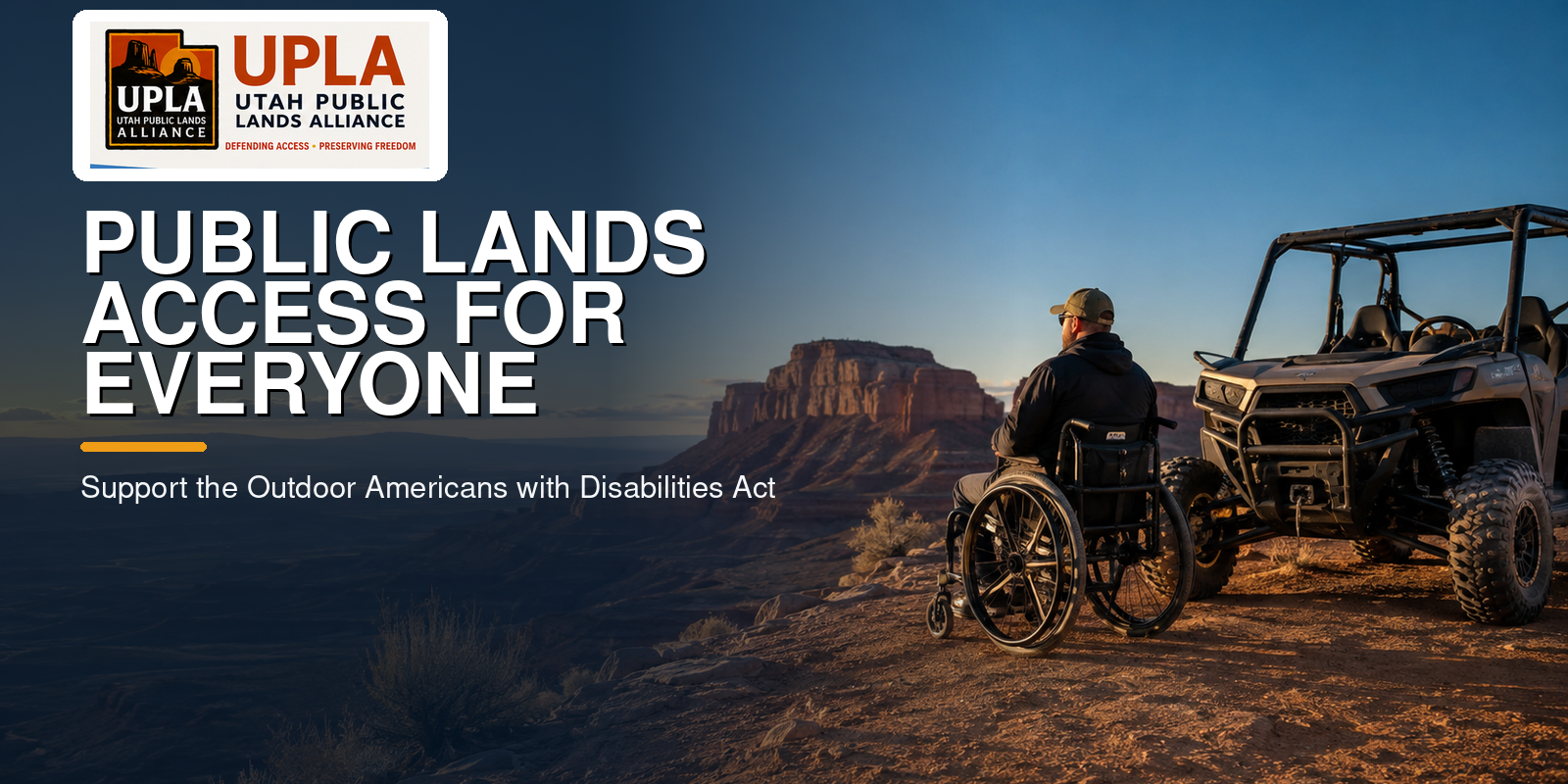
For many Americans with disabilities, wounded veterans, older adults, and people with limited mobility, a motorized vehicle is not simply a recreational convenience. It is their means of access. It allows them to reach a scenic overlook, campsite, fishing area, hunting location, historic site, or backcountry destination that would otherwise be completely beyond their reach.
When a federal agency closes a road or motorized trail, an able-bodied visitor may still be able to hike or bicycle into the area. A person with a mobility limitation may lose access entirely. That is why the Utah Public Lands Alliance strongly supports the Outdoor Americans with Disabilities Act.
What the Legislation Does
The Outdoor Americans with Disabilities Act would require the Bureau of Land Management and U.S. Forest Service to make disability access a meaningful part of federal travel management decisions.
The legislation has now been introduced in both chambers of Congress in exactly the same form. You can see the actual bills here.
- 2968 was introduced in the Senate by Senator Mike Lee, with Senator John Curtis as a cosponsor.
- R. 9221 was introduced in the House of Representatives by Congressman Mike Kennedy.
Among its major provisions, the legislation would:
- Establish a measurable standard for disability-accessible public land based on the availability of authorized motorized roads and routes.
- Require the Department of the Interior and the Forest Service to consider accessibility when updating travel management plans and motor vehicle use maps.
- Prioritize roads that provide access to a variety of recreational opportunities.
- Require coordination with state, county, local, and Tribal governments when identifying important access routes.
- Restrict road closures that would cause an area to fall below the bill’s accessibility standard, except for emergencies or significant safety concerns.
- Require an alternative route when an important access road must be closed.
- Give local communities and the public a greater voice before access is eliminated.
Accessibility Cannot Be an Afterthought
Federal land managers carefully evaluate how proposed road closures could affect wildlife, soil, vegetation, water, cultural resources, and other environmental concerns. Those are important considerations.
But the effect of a closure on people with disabilities is too often treated as an afterthought—or not meaningfully considered at all.
That must change. The Outdoor Americans with Disabilities Act would make accessibility part of the travel-management process from the beginning. It recognizes that motorized access can be a form of adaptive access and that eliminating a road can have a dramatically different effect on a person who cannot simply continue the journey on foot.
In February 2026, S. 2968 received a legislative hearing before the Senate Energy and Natural Resources Subcommittee on Public Lands, Forests and Mining. In its official testimony, the U.S. Forest Service said the Department of Agriculture supports the intent of the legislation and is willing to work with its sponsors on implementation.
That is encouraging, but introduction and a committee hearing are only the beginning. Passage will require support from members of both parties and from elected officials across the country.
Disability access should not be a Republican issue or a Democratic issue. It is an American issue.
We Need Your Voice
We are beginning an effort to build support for this legislation from individuals, organizations, clubs, businesses, veterans’ groups, adaptive recreation programs, local governments, and disability advocates throughout Utah and across the country.
You can help by:
- Sharing your personal experience with disability, limited mobility, or motorized access.
- Telling us about a road closure that prevented you or someone you know from reaching a public-land destination.
- Providing photographs or examples showing how motorized access allows people with disabilities to participate in outdoor recreation.
- Using the official USAGov elected-official lookup to find the names and contact information for your U.S. representative and senators.
- Asking your representative to cosponsor H.R. 9221.
- Asking both of your senators to cosponsor S. 2968.
- Encouraging your club, organization, business, county, or community to formally endorse the legislation.
- Sharing this article so we can reach people whose experiences need to be heard.
- If you have a story to share or want your organization added to the growing list of supporters, please contact UPLA.
Access Is More Than Recreation
For people who can easily walk long distances, a closed road may mean a longer hike. For a person with a disability, that same closure may mean never seeing that place again.
Motorized access provides independence. It supports physical and emotional health. It allows veterans to reconnect with the landscapes they defended. It lets parents and grandparents continue outdoor traditions with their families. It gives people with disabilities the freedom to explore, camp, hunt, fish, photograph, volunteer, and experience the same public lands that belong to every other American.
The Outdoor Americans with Disabilities Act is an important step toward making sure federal land-management decisions recognize that reality.
Public lands belong to all of us. Access to them should not depend on whether someone can hike ten miles to get there.