

Dino North Travel Management Plan: A Different Kind of Travel Plan
For years, Utah Public Lands Alliance has argued that Travel Management Plans should not become exercises in simply reducing motorized access. If routes exist on the ground, serve a public purpose, and can be managed responsibly, they deserve an honest evaluation—not automatic closure.
The Draft Dinosaur North Travel Management Plan is different.
Unlike many recent travel plans that focused primarily on reducing access, the Dinosaur North proposal evaluates an existing transportation network that is far larger than the routes designated in the 2008 Vernal Resource Management Plan.
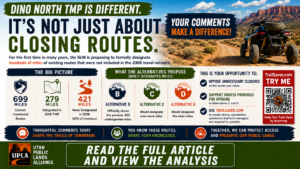 Our analysis of the Draft Environmental Assessment shows that the current inventoried route network contains approximately 700 miles of existing routes, yet only 279 miles were formally designated in the 2008 Travel Management Plan. That means roughly 421 miles—about 60 percent of today’s inventoried network—were never officially designated for motorized use in 2008. The Draft EA explains that those undesignated routes are treated as closed under Alternative A because they were never formally evaluated or designated. That makes Dinosaur North fundamentally different from most recent Travel Management Plans.
More Than a Closure Analysis
In recent years, much of UPLA’s work has focused on defending existing access against unnecessary closures. That work remains critically important.
Alternative B would still close many existing routes that riders, hunters, campers, photographers, rockhounds, and other public land users value. If you use those routes, your comments remain essential.
However, Dinosaur North also presents something we have long encouraged the Bureau of Land Management to do. It is one of the first major examples where the BLM is proposing to formally designate existing inventoried routes that were not included in the 2008 travel network, almost 400 miles. Rather than simply deciding which routes to eliminate, the agency has evaluated hundreds of miles of existing routes that have long existed on the landscape but were never officially designated. Alternatives C and D would incorporate many of those routes into the official designated transportation system.
That represents the kind of comprehensive route evaluation UPLA has advocated for years.
Your Comments Can Make a Difference
Most people naturally focus on routes proposed for closure. You absolutely should.
If Alternative B proposes closing a trail that provides meaningful recreation, access to hunting areas, campsites, overlooks, historic sites, or connects other important routes, tell the BLM exactly why that route should remain open.
But don’t stop there.
The 400 miles of newly proposed designations deserve your support as well. If a route appears on UPLA’s Newly Designated Routes worksheet and you believe it should become part of the permanent designated transportation system, tell the BLM why that designation is important.
Use TrailSaver.com to format your comments to describe how you use the route, what destinations it provides access to, why it contributes to a connected and sustainable trail system or why formally designating the route improves responsible public access.
Positive comments supporting appropriate route designations are just as valuable as comments opposing unnecessary closures.
Make Your Comments Substantive
Simply saying “keep this trail open” or “I oppose closures” carries very little weight during the NEPA process.
To influence the decision, your comments should be substantive. That’s exactly why UPLA developed TrailSaver.com. 
TrailSaver walks you through a series of simple questions about the specific route you use. Based on your answers, it generates a detailed, route-specific comment that addresses the kinds of information land managers are required to consider during the decision-making process. The better your answers and more details you provide, the stronger your comment becomes.
Whether you’re commenting on a route proposed for closure or supporting one of the newly designated routes, TrailSaver helps you create comments that are far more likely to be considered substantive rather than general expressions of support or opposition.
A Better Conversation About Public Lands
Travel management should never be viewed as a choice between opening everything and closing everything.
Good travel planning identifies the routes that provide meaningful public access, protects sensitive resources where necessary, and creates a transportation system that is both sustainable and usable for future generations.
The Dinosaur North Draft TMP provides an opportunity to accomplish exactly that.
Where the BLM proposes unnecessary closures, UPLA will continue advocating to keep valuable routes open.
Where the BLM proposes to formally designate long-existing inventoried routes that were never included in the 2008 travel network, we believe those proposals deserve careful public support when they improve responsible public access.
Both deserve your attention.
To help the public better understand this planning effort, UPLA has expanded its TMP Analysis System to identify not only proposed closures, but also Newly Designated Routes—existing routes that were not designated in the 2008 Travel Management Plan but would become officially designated under Alternatives B, C, or D.
We encourage everyone reviewing the Dinosaur North Draft TMP to look beyond the closure statistics. Study the routes proposed for closure. Study the routes proposed for new designation.
Then use TrailSaver.com to prepare detailed, substantive comments supporting the routes that matter to you.
We are finally beginning to win this battle, but we need your support and engagement to bring it over the finish line.
Thank you for all your Support!
Loren Campbell
President