Stop The Sale of Sand Mountain!

BLM and the Washington County Water Conservancy District have proposed a land exchange that would involve swapping 1050 acres of the Western Edge of Sand Mountain near Warner Valley with 89 acres of land in Washington near Green Springs, apparently owned by His Family Natters/Allan Carter. Washington County is designated as the Facilitator of the Exchange. You can learn more at the BLM E Planning website,  EplanningUi (blm.gov). You can also see the Public Scoping Notice which is attached.

We also obtained plans by the City of Washington to annex much of the acquired area into their City, which may be a significant influence in the exchange.

The proposed action just entered the Public Scoping phase, which is scheduled to conclude at 5:00 PM on April 13, 2023. UPLA, DRATS, Mayor Nanette Billings (Hurricane), BlueRibbon Coalition, and Tri State ATV have been meeting with BLM, Water Conservancy, and the City of Washington to learn more about the project.

We attached a couple illustrations to show the following:

  • An Overall view of the Washington City Annexation Plan, which shows the proposed BLM Exchange areas, the new Washington City Annexation, and the proposed reservoir in the valley.
  • In this photo, you can see the Red Outlined section was the land originally requested in October 2022, and the Green Outline shows the expanded area they added in February. The exchange and City Annexation include all of the area around the Pipeline Road and disbursed camping sites, and portions of West Rim including the Steps and The Funnel. It also shows our proposal to push the land exchange back to the 2950’ elevation right around the reservoir edge.


We were previously informed when the reservoir was done, we would lose the lower parts of Fault Line and Sandcutter, as well as the camping/staging area near Hwy 7, but when we learned that, we constructed the Ridgeline Trail at substantial expense to maintain access from Warner Valley.

We are extremely concerned for many reasons, including the following:

  • BLM will give up 1050 acres of Sand Mountain in exchange for 89 acres in St George
  • We will lose access to the West Rim Trail, the Restroom on Pipeline Road, the disbursed camping areas, and possibly the Ridgeline Trail we constructed to mitigate the reservoir loss.
  • We will lose staging and camping in Warner Valley
  • There has apparently been no decision about what agency would oversee recreation in the newly acquired area, but it seems likely it will become a fee area.
  • If access to Sand Mountain is impaired from Washington Dam, it will impact the load on other roads including our newly constructed Waddy’s Corral Staging area.
  • We are extremely concerned that the City of Washington will be annexing the land surrounding Pipeline Road and West Rim, and that they may permit development on top of the Rim; the views over a lake will skyrocket land values. Development would bring a whole host of issues including loss of the tremendous views from above by having buildings/homes on top of the ridge, user conflicts between residents/occupants and OHV users.
  • We only have 30 days to inform the public and submit scoping comments.

We have been working hard on this for 4 weeks to get this information. This is the part where we need you!

What we need you to do:

Attend the Public Scoping Meeting and voice your concerns. next Tuesday, March 21 from 5:00 to 7:00 at the St George Library, Forsyth Community Room B, 88 W 100 S, St George, UT 84770

We will inform the media of the event and urge them to cover it, so we urge you to drive your 4x4s and street legal machines to the meeting to show the level of concerns on this.

We have a great relationship with BLM in the St George Field Office, and it is very important that we are vocal, but respectful during the meeting. It is very likely that the crowd may exceed the capacity of the room, so please be patient. Representatives from BLM will meet with small groups of people at a time. They will also provide Comments Forms to you and help you learn how to submit them.

Following is a brief description of the Scoping process in the NEPA Review that may guide you in formulating your questions/comments for the meeting. We will have a handout for you when you enter the meeting.

The National Environmental Policy Act (NEPA) requires the Bureau of Land Management (BLM), to involve the public in the planning process and seek their input through a scoping process. Effective NEPA scoping comments for BLM should pose the questions or issues to be looked at, not provide answers.

  1. Specific information about the proposed project and its potential impacts on the environment and local communities.
  2. Identification of any alternatives to the proposed project that could mitigate or avoid potential negative impacts.
  3. Discussion of the potential cumulative effects of the proposed project in combination with other past, present, and reasonably foreseeable future actions.
  4. Analysis of potential impacts on wildlife, water resources, cultural and historic resources, and other sensitive environmental resources.
  5. Request for meaningful public participation throughout the NEPA process, including opportunities for public comment and involvement in decision-making.
  6. Request for transparency and disclosure of all relevant information, including scientific data and analysis, underlying assumptions, and potential conflicts of interest.
  7. Discussion of any potential economic impacts of the proposed project, including impacts on local jobs, property values, and tax revenue.
  8. Recommendation for monitoring and mitigation measures to minimize or address any adverse environmental impacts.
  9. Discussion of any potential long-term impacts of the proposed project on the environment and local communities.
  10. Request for BLM to consider the full range of alternatives and potential impacts, rather than limiting the analysis to a narrow set of options.

Stop The Sale of Sand Mountain is a joint effort by these local organizations.


Matt’s Off Road Wrecker Olympics is UPLA Fundraiser

Come out and help support Matt’s Off Road Wrecker Olympics March 8-11 at Sand Hollow State Park. Matt’s has generously agreed to make a donation to Utah Public Lands Alliance for our help in getting volunteer staff for the event.

The schedule of events will be:

  1. Wednesday will be preregistration, so we will need help at both in Sand Hollow State Park to setup the vendor area, and at Sand Hollow Resort to check people in and give directions.
  2. Thursday all of the events will be in the staging area near the tunnel. Volunteers will be
  3.  assigned to help with registration, wrecker events such as Welding Competition, Dead Vehicle Pulls, Rollover Recovery, Flex Off and More. We will also need help with the vendor show at the end of the day. We will need to cover 62- 4 hour s
    hifts this day.
  4. Friday will be on the Mountain at Triple 777s. Mad Moose is donating 50 SxSs we will use for our volunteers to shuttle people up and down the mountain to 3 different viewing areas where the competition will be held. Drivers for this will need to be at least 25 years old and must have the OHV Education Course Certificate. We will need to cover 100- 4 hour shifts on this day, so we need a lot of people to signup for Friday, the majority of which will be assigned to drive the SxS’s to shuttle people
  5. Saturday will a vendor show, closing ceremony and cleanup activities.

To sign up, you need to do 2 things….

  1. click on this link to select the shifts you’d like to be assigned

AND

  1. Complete this volunteer information sheet to indicate your t shirt size

It will be a fantastic and exciting event, and you’ll have plenty of time to enjoy all the activities. Every volunteer will receive a t shirt, water, and snacks.


Legislation is a Lot Like Making Sausage

People say sausage making is not a pretty process, but it sure tastes great when you put it on the grill. The same can be said about politics and legislation. UPLA has been busy in the sausage making business of monitoring and contacting the Sponsors about bills

  • HB 384 (Representative Jeffrey Stenquist) was making changes to the Outdoor Recreation Infrastructure funding that did not give OHV and Boating a strong voice at the decision making table on the distribution of funds received from Sales Tax. We still have the Director of DNR as a voting member, and we were able to get our OHV and Boating Program Managers with Advisory Seats on the 15 member panel. This bill does not affect the Restricted OHV funds, which do keep OHV and Boating Program Managers as Voting Members on approving grant requests.

that we are interested in.  I am very proud to say that we have a very capable and skilled team in working with legislators to get bills authored, edited, and passed or defeated that affect Outdoor Recrreation and our public lands.

These are 760 bills available in this current legislative session, these are the ones we have been actively engaged in:

Passed

  • HB 55 was a cleanup bill to last year’s OHV Education bill to fix some issues with the license and registration processes. No significant changes to OHV or the original OHV Education Bill.

Support or Watch

  • HB 262 (Representative Casey Snider) was a bill that would have restricted access to Wildlife Management Areas throughout Utah to only people with current valid hunting or fishing licenses. We strongly opposed this change, and worked with the Sponsor of the bill to have that requirement removed. The bill has been set aside for now with no further action, but we are watching it.
  • HB 299 (Representative Casey Snider) is a Bill modeled on the OHV Grant Program but for Boating. The OHV Restricted Fund grants have been very popular. We are very pleased that this original bill sponsored by OHV advocates has become a model in Utah and many other states in adopting programs for outdoor recreation. We are in full support of this Bill.
  • HB 444 (Representative Jeffrey Stenquist) is a companion bill for Grant Funding for Recreational Vehicles, based on our OHV Grant Program. We are very pleased that this original bill sponsored by OHV advocates has become a model in Utah and many other states in adopting programs for outdoor recreation. We are in full support of this Bill.
  • HB 421 (Representative Jefferson Moss) is a bill that will give the State Legislature control over the Utah School and Institutional Lands Trust Administration (SITLA) SITLA is charged with administering lands granted to the trust by the Federal Government when Utah became a State. The purpose is to support schools and education. Largely, SITLA has operated independently with little oversight, this bill gives the Legislature financial control over SITLA. We strongly support the passage of this bill
  • HB 200 (Representative Stephanie Gricius) is a bill that eliminates a prior provision that made transporting an unregistered OHV vehicle an infraction. This bill eliminates that. We strongly support this bill.

One thing you can count in politics is that nobody ever gets everything they want, but all of the Representatives associated with these bills have listened to our arguments and most  of them have have adopted amendments. This caused us in many cases from Opposed or Watch Closely to Support. We’d like to recognize them for their willingness to listen to us and adjust their bills.

Overall, we think the result has been some decent tasting sausage, but I’d love to hear what you think. If you know of a bill related to use of Public Lands that needs our attention, please let me know.


Loren Campbell
President, UPLA
President@UtahPLA.com


OHV Safety Education and Registration Requirements

H.B. 0180, the Off Road Vehicle Safety Education act, was passed in the 2022 Legislative Session with an effective date of January 1, 2023. Enforccement will not begin until February 1, 2023. This article is to summarize the interview with Chase Pili, the DNR OHV Program Director, and Kevin Mortensen from Ride Utah. The full video can be watched at https://youtu.be/_EtjOtk48ek

Why the Change: There has been a huge increase in OHV use in Utah since 2020. This bill has been in the works for the past 3 years and was prompted by efforts to reduce the number of complaints associated with Off Highway Vehicle use, both on trails and on the streets. The bill was authored by OHV advocates after considerable input from OHV users of all different types. from a wide variety of users types.

What are the Rules for Registration Requirements? Utah Residents will be issued hard plates for street legal OHV vehicles as they have been in the past. OHV registration stickers will be replaced with a special OHV tan hard plate when current registration expires. This will require a trip to the DMV the first time to get the plate. Renewals after you are issued a plate can be done online. Stickers will still be issued for OHV registration for all motorcycles and snowmobiles. Hard plates will make it easier to identify and report bad actors without conflict.

Out of State Residents must apply online (www.OHV.Utah.Gov) for their OHV Permit. The sticker will be mailed to them, but they will be issued a temporary if they are already in the state. You will be required to provide proof of course completion to complete your application.

Who must take the OHV Course? Every OHV driver 18 years of age or older that recreates on public lands must take the class. By definition, this includes Type 1 (ATV), Type 2 (UTV Sxs), Type 3 (Non Street Legal Full Size-Buggies), and Off Highway Motorcycles. Both Utah residents and non residents must take the course, including those that rent vehicles. E-Bikes are not considered OHV vehicles and are not subject to the course requirements.

Street Legal Full Size Vehicles (i.e. Jeeps), snowmobiles, husbandry vehicles or registrants at a sanctioned OHV event are exempt and not required to take the course.

More about the course The course is FREE to everyone, if you go to a website that charges a fee, you should go back to www.OHV.Utah.Gov It takes about 20-25 minutes and includes questions in each section that you must answer correctly to complete it (The answers are in the text right above the questions)

What about the Youth Course? If a driver is under 18, they must take a Youth course as they have in the past. The cost for the Youth Course is the same $35 that has been charged for years, and can be done online or in person. When a person completes the Youth course, that Certificate will be good for life, they will not have to take the Over 18 course. A separate change was also made last year that allows youth of any age to take the class as long as they can safely operate the controls (the minimum age was 8 year)

How do I prove I took the course? After completion, you can download a digital copy for your phone or print it out. I recommend if you store it on your phone as a picture you put it in a special folder or mark it as a favorite to make it easy to locate.

What are the penalties for violation of the rules?  Fines may be levied for violations as they have been in the past by law enforcement and local courts, and are considered either infractions or Class B or C misdemeanors. A new provision applies to users that cause damage to trail systems which will add to any fines the requirement that the court shall order the person to perform community service in the form of repairing any damage to the public land in the area where the damage occurred. The court shall determine the approximate value of the damage caused and calculate the number of hours required by using the rate of $25 per hour. What does this mean? If a violation causes $2500 worth of damage on a trail, they will be required to perform 100 hours of community service in the local area. Being ordered to do 100 hours of work by a court is probably not what most people would want to do on their time off, especially if they have to travel far from home and incur travel expenses.

Contrary to many people’s comments online, fines assessed do not go into the OHV budget, they are assessed by local municipalities.

Summary We should not expect this course or the registration changes to completely eliminate complaints, but whatever improvement we get will help us in our fight to keep trails open. Education will always be our best resource to keep our trails open!


Bears Ears National Monument Poses Devastating Loss to OHV

How to Protect OHV in Bears Ears National Monument

The Bears Ears National Monument (BENM) was restored in size by President Joe Biden to 1,360,000 acres, making it one of the largest in the country. As a result, a new management plan is being developed that will decide how the land will be managed (used). The Scoping Document BLM prepared will be one of the largest eliminations of OHV use I’ve ever seen. Some of the most popular OHV routes would be Arch Canyon, Hotel Rock, Lockhart Basin, Beef Basin, Bridger Jack Mesa, Lavender Canyon, and Davis Canyon, with many, many more subject to the axe.

And it won’t just affect OHV use, if you are a hiker, dispersed camper, miner, drone pilot, or equestrian user that depends on access roads to get to your favorite sites, you will also be extremely limited on your use of the BENM under the current proposals.

BENM is a huge area with very diverse uses and landscapes,and is surrounded by other currently protected areas including National Parks, Wilderness, Wilderness Study Areas, and even another National Monument already contained in its massive boundaries. BLM’s scoping document should make the alternatives easier to understand, but this one makes it even more complex. NEPA requires that BLM and USFS consider a reasonable range of alternatives in their plans. OHV use is already limited in the entire BENM, meaning that you may only operate on designated routes. In addition, OHV use is already prohibited in Designated Wilderness (DW), Wilderness Study Areas (WSA), and Inventoried Roadless Areas (IRA),

Alternative A is the No Change required alternative. It is generally provided as a requirement to the “full range of options” legal requirement. It is always included as an obligatory placeholder,and is almost never selected in the final draft. Target shooting and drone operation would be permitted with some restrictions under this Alternative.

Lands with Wilderness Characteristics

Alternative B adds Lands with Wilderness Characteristics to closure by OHV, as evidenced by the following chart which indicates how much of BENM will be closed to OHV. The BLM website states that for an area to qualify as lands with wilderness characteristics, it must possess sufficient size, naturalness, and outstanding opportunities for either solitude or primitive and unconfined recreation. It may also possess supplemental values.

The addition of “lands with wilderness characteristics” is an enormous tract of land depicted in the green hashed marks that will affect much of the 1800 miles of OHV routes, as well as many connecting routes between areas that will be cutoff from motorized vehicles. In addition, other special use restrictions such as limits on group sizes and permits will be required.  In addition, target shooting and drone would be prohibited throughout the entire BENM.

Alternative C will probably be considered as the “balanced” approach, but it is definitely not for OHV and many other forms of recreation. It would divide the BENM into many different Recreation Opportunity Spectrum (ROS) zones, which all will have different limits and regulations  on use. The language regarding this is not only vague, but contradictory in nature. It also includes “lands with wilderness characteristics” as being Closed to OHV. The language regarding road density and sitage is extremely vague, but their intent seems clear.This Alternative would allow  some limited drone use and target shooting could be done in the “front country” or in designated ROS zones.

Alternative D is Orwellian in scope, adding to the “lands with wilderness characteristics” 3 additional restrictions with no formal definitions.

  • 1) Areas where OHV use has damaged or is a current or foreseeable future risk to the protection, restoration, and resiliency of BENM objects and values. If the authors of this proposal are the unelected bureaucrats deciding this, we are in trouble.
  • 2) Areas where OHV use affects traditional use and cultural setting
  • 3)With the exception of existing designated routes, areas within 300 feet of riparian habitat, perennial springs, and other perennial aquatic ecosystems

Another statement in Alternative D is that “in OHV limited areas, road density would be minimized, and siting criteria would be identified, especially in important resource areas, to ensure the protection, restoration, and/or increased resiliency of BENM objects and values. Future implementation-level travel planning would not allow designation of additional routes but would focus on refining (as needed) the existing designated route network.” Target shooting and drone usage would be prohibited throughout the BENM. In Alternative D, your visit to Bears Ears may very well be limited to driving through in your passenger car with no dispersed camping opportunities, and complex rules that will almost ensure users will be in violation of one of them.

Current Trails Overlaid with Proposed Zones

This map shows the complex network of designated areas, along with trails and roads overlaid onto it,


clicking here will display the map in greater detail. . Virtually all of the color shaded areas on this map will be restricted from OHV use.

There is no good alternative from this range of choices, so the best approach at this point is just to tell them you protest the array of current Alternatives, to complain about the lack of clarity on their entire RMP, and to comment on how you have used the area in the past, or plan to use it in the future. Some of the things you might mention are:

  • How long and how often you’ve been coming here
  • Who you have brought to visit the area
  • Activities you’ve engaged in, OHV, Dispersed camping, hiking, equestrian
  • The nature of any conservation efforts you have engaged in, whether it is in BENM or other public lands
  • Specific trails that you enjoy, or plan to enjoy. Specific trails identified now are Arch Canyon, Hotel Rock, Lavender and Davis Canyons, Chicken Corners, Lockhart and Beef Basin, and the Peavine Corridor.
  • If you have mobility or disability issues that limit your visitation


Comments are only being accepted until October 31, so please Visit Blue Ribbon Coalition’s website and complete their comment writer.
if you want to send personal comments about trails you use, submit them on the BLM E-Planning website.


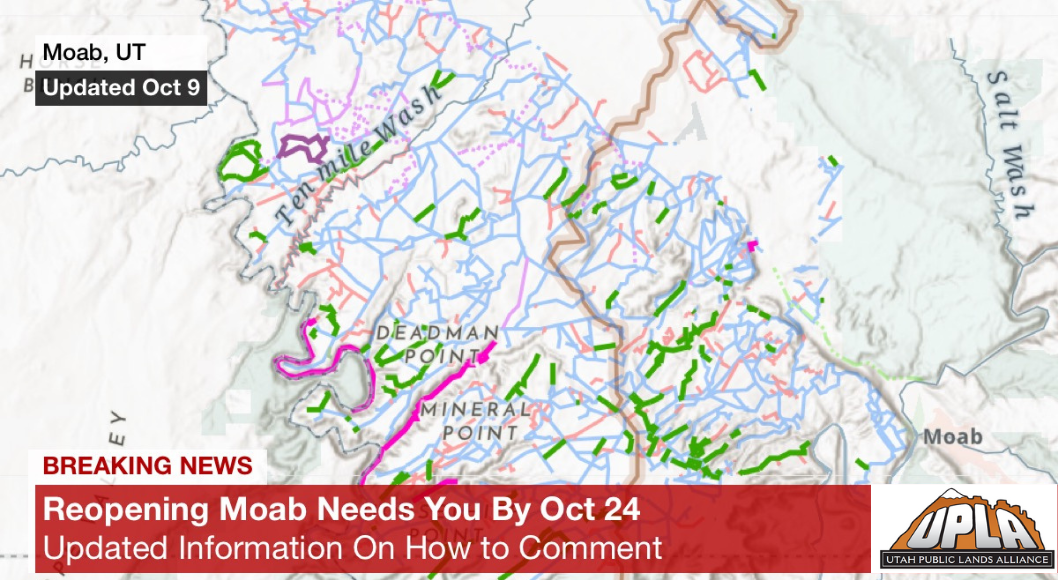
Running out of time for final Moab comments

Please submit your final comments on your favorite Moab trails to keep them open. The extended Comment period ends Friday.

If you haven’t submitted comments, please do it today.

If you have submitted comments, thank you.

If you want to see more details about exactly which trails are threatened, including maps, guides, and photos, please look at our friend Patrick McKay’s comments here. His comments total 527  pages, and is chock full of information to let you share your personal experiences with trails that will be affected. Please don’t copy and paste his comments, but use it as a reference to help you write your own.

Please submit any final comments by going directly to the BLM website

                                                          Thank you very much!