What Has UPLA Done For You Lately
 Trail Hero is sponsoring the first Offraod Car Show and Swap Meeting on Saturday May 20 from 12:30 to 8:30, come out and enjoy:
– Free Prize Drawings for Spectators & Participants!
– Dixie 4WD Flex Contest
– Matt’s Offroad Recovery Photo
– Fab Rats Staged Tow Rig Photos
– Stapley Pharmacy’s People’s Choice Awards
– Music
– Food Trucks
– Beach Sunset Tailgate
This is not your typical show & shine car show! Scratches, dents, rust, dirt, etc are welcome and preferred.
Matt’s Offroad Recovery and Fabrats will bring their tow rigs, and for a donation to UPLA they will hook your rig up for Photos with Matt and Paul. Donations to UPLA will support efforts throughout Utah to Keep Your Trails Open.
The event is FREE, but you can preregister for a booth, make a donation, or schedule a photo op at www.OffroadCarShow.com
Come out and join us for a day of fun at Sand Hollow and Support UPLA at the same time.
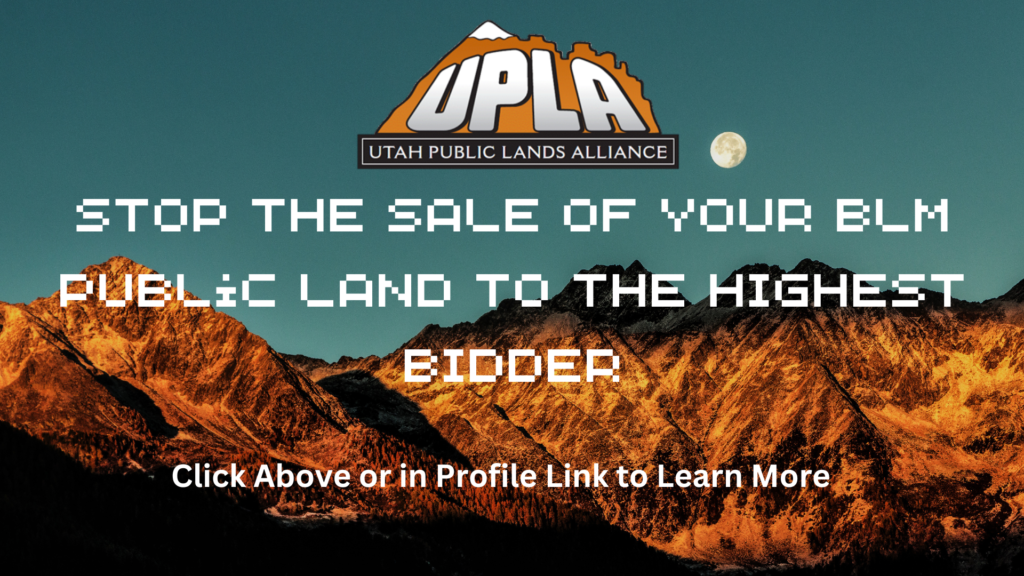 The BLM is considering a rule that could devastate our access to public lands. Watch this short video from Ben Burr at BlueRibbon Coalition to learn why you should be concerned.
The BLM is accepting public comment until June 20, 2023 on a proposal to adopt the BLM Conservation and Landscape Healtlh Rule BLM-2023-0001-0001 (Click to see the entire Highlighted Rule) which could lead to massive restrictions for public land access across all lands managed by the Bureau of Land Management. Following is an article that explains the basis for our concern, and will be used by UPLA as a starting point for comments to be submitted.
I enjoy accessing and recreating on public lands. I believe BLM managed lands are crucial to the health and well being of our country. Access for many different user groups is crucial. I am writing to provide feedback on the proposed conservation and landscape health proposed BLM rule. I do not support the rule as it stands and believe it will be detrimental to public land across the United States. I think FLPMA, as it stands does a sufficient job in directing management of our public lands and should not be altered with the proposed changes.
Conservation is already rooted heavily in land management, and does not need to have additional complex levels of rules that would benefit wealthy organizations rather than the US Citizen. The rule establishing that “conservation” be defined to include both protection and restoration is especially troubling.
There should not be a stated objective of BLM to prioritize designating new ACEC’s, which are often used to restrict public access. There are already substantial methods in place such as congressionally designated Wilderness and Wilderness Study Areas which restrict land management uses, and there should not be more prioritization for designations of land that could harm use such as ACEC’s.
The broad use of the terms “intact, native habitats” and “degraded landscapes” are troubling, vague, and unclear. Theoretically, if a person ever walked on land and left a footprint, that land could be defined as a “degraded landscape” or one that is no longer intact or native. These terms are used in key recitals in the document, without any definition of what they actually mean. Page 10 states “The proposed rule would define the term “intact landscape” to guide the BLM with implementing direction. The proposed rule (§6102.1) would require the BLM to identify intact landscapes on public lands, manage certain landscapes to protect their intactness, and pursue strategies to protect and connect intact landscapes.” Although the rule states that BLM would define the term, there is no definition present. The same is true with the terms “landscape” and “intact landscapes” on Page 11. There are many other instances of terms that are not clearly defined in the document, which means the definitions and intent of the rules will have to defined by the courts and the teams with the best lawyers.
The proposed conservation leases make it possible for entities to essentially buy off our public lands for their own selfish purposes. The BLM should not be selling the land through these leases to the highest bidder restricting all other forms of use on public lands that benefit our nation in various ways. Only the best funded entities will have a chance to qualify and buy these leases, again removing the majority of users from participating.
We are extremely concerned that conservation extremist groups, such as Sierra Club and SUWA, would have the financial resources to bid on these leases to “restore” the land back to it’s natural condition, and to develop their own plan to “mitigate” the conservation activities by restricting access. Although the term of the leases is limited to 10 years, there are extensions allowed until the outcome is achieved. Based on prior experience, this would include removing roads and dispersed camping, which is the path to having the area declared as a Wilderness area resulting in even broader access issues.
It is also likely that this rule will be utilized as a tool for socioeconomic class discrimination. It is already common for conservation easements to be used by wealthy landowners in gateway Western communities to prevent development and turn these communities into enclaves for billionaires. The subject of this as a tool for wealthy or prospective landowners has even reached media in the Yellowstone Series. Conservation leases are used as a tool to keep the middle classes and working classes away from what eventually become private nature preserves for the wealthy. To spread this toxic outcome across the hundreds of millions of acres of BLM land is completely misguided.
The adoption of Conservation Leases should be stricken completely from the proposed rule.
Conservation is already used to restrict, regulate and deny access to public lands. By codifying conservation as a use, environmental groups will be given even more power to lock out the public from public lands. Lands are already sufficiently being conserved by various laws and Executive Orders such as NEPA, Clean Air Act, Clean Waters Act, Antiquities Act, Endangered Species and many many more. I do not believe the proposed rule is warranted or necessary. In order to gain better compliance, less complexity is needed in rulemaking, not more.
The rules requiring decisions be evaluated based on complex “high-quality science” removes the ability for all but the most well funded organizations to submit their “evidence.” Science is a study, and is generally composed of all different views of a subject. By codifying this as a requirement, it eliminates lesser funded organizations and citizens from making substantive comments that may represent a less restrictive approach to conservation. It has long been stated that if the consequences are high enough, you can always find an expert to testify on your behalf. This rule is simply not needed and will again remove the ability for users to participate in substantive comments.
Economic effects must be considered and analyzed. BLM needs to more fully analyze the effects that would result from the proposed rule. Recreation is a huge economic driver across BLM managed lands as well as other uses such as grazing and mining. These changes could greatly affect access in general for all users on public lands and that analysis and data needs to be available to the public to submit thoughtful comments. The BLM also needs to fully understand the depth of the effects from the proposed rule.
Every time motorized routes are closed, people with disabilities that require the use of motorized means to access public lands are barred from those areas forever. In the past, there has been little resource available to people with disabilities because the American with Disabilities Act does not require public land management agencies to consider disproportionate effects on the disabled community, requiring only that there is equality of opportunity. This has resulted in the BLM’s historical failure to give any real impact to the effects on the disabled community.
On his first day in office, President Biden issued an “Executive Order on Advancing Racial Equity and Support for Underserved Communities Through the Federal Government” This changed the equation, now requiring focus on equality of outcome rather than the prior equality of opportunity. Allowing closures of public lands through any of the methods outlined in the Rule will further the longstanding discrimination towards American with disabilities within federal land management agencies. The entire rule should be eliminated from consideration entirely because it will adversely impact disabled users in their outcome of enjoying public lands.
It is also likely that this rule will be utilized as a tool for socioeconomic class discrimination. It is already common for conservation easements to be used by wealthy landowners in gateway Western communities to prevent development and turn these communities into enclaves for billionaires. The subject of this as a tool for wealthy or prospective landowners has even reached media in the hit television series “Yellowstone”. Conservation leases can be used as a tool to keep the middle classes and working classes away from what eventually become private nature preserves for the wealthy. To spread this toxic outcome across the hundreds of millions of acres of BLM land is completely misguided.
The Federal Government already has enough protections available to protect our available resources, reject this Rule in it’s entirety.
Please submit your comments to prevent this rule from taking place with these sweeping changes. We encourage you to submit your detailed comments in either of 2 ways.
Thanks in advance for your support in taking action against this proposal.
Remember,
Together We Can Win,
But We Can’t Do It Without You
Loren Campbell
President
Learn How You Can Help Us Achieve our Mission at http://www.UtahPLA.com/help
When we come together, we can accomplish great things. The proposed BLM Sand Mountain Land Exchange posed a serious threat to both the OHV community and Dispersed Campers that used Warner Valley. When we raised a Call to Action to the Community, nearly a thousand of you turned up at the St George Library for BLM’s scoping meeting with only 4 days notice. Hundreds of you submitted scoping comments, including some of the most substantive comments I’ve ever seen. Your response set the stage for how committed the OHV community was in protecting Sand Mountain and helped us immensely in negotiating with BLM, Washington County Water Conservancy District (DISTRICT), and the City of Washington.
The team that negotiated on behalf of the OHV community consisted of Jeff Bieber from DRATS, Ben Burr from BlueRibbon Coalition, Milt Thompson from Dixie 4 Wheel Drive, Steve Jacobs from Tri State ATV, Steve Maxfield and Casey Lofthouse. I had the pleasure of leading the team as the representative from Utah Public Lands Alliance. Together, we spent many hours, weeks, and months strategizing and meeting with 4 different government agencies to find a mutually agreeable solution.
I must recognize the leaders of the agencies for taking the time and effort to understand our needs and respond to them. Jason West, BLM Field Manager was always quick to respond to our inquiries and set up our initial meetings with the DISTRICT. Mayor Nanette Billings from the City of Hurricane setup our first meeting with the City of Washington, Mayor Kress Steheli. General Manager Zach Renstrom and Attorney Morgan Drake from the DISTRICT spent many hours working with us and refining the agreement and working document. Both Mayor Steheli and Jason West went on field trips with Jeff Bieber and I to tour to affected parts of Sand Mountain, and to show them the work the OHV Community has done on Sand Mountain. Morgan Drake and Zach Renstrom organized a field trip in UTVs for DISTRICT staff and Board members to view the mountain for themselves. They got a first hand experience of why we’re so proud and protective.
Last night, the DISTRICT Board passed a Resolution unanimously that identified the protections the OHV Community needed, as well as limited protection for Dispersed Camping until we can find another option. The Resolution, Map and Press Release can be seen here.
As stated in the Board Meeting last night by Morgan Drake and Mayor Kress Steheli from the City of Washington, this has been an excellent example of how difficult land use decisions can best be worked out when everyone sits at the table and work together to find a solution. Is it a solution that everybody got everything they wanted? No, that only happens in fairy tales. Is the work over? No, there’s still work to be done in the coming months-but this was a very important milestone for us because BLM will insert these conditions into the terms of the Land Exchange if it is approved.
We still have several review processes to complete with the NEPA process, and we’ll be asking you to reengage as those came up. But a sincere thank you to everyone that participated in this effort for a successful outcome.
Remember this for the future…
Gratefully and with Sincere Appreciation,
Loren Campbell
President
Utah Public Lands Alliance
UPLA led a joint service project on Sand Mountain together with Desert Roads and Trails Society, St George Jeepers, and Ride Utah to further improve the Sand Mountain OHV experience. BLM contributed materials and actively participated in the project. Loren Campbell said this project was a milestone in the OHV community as the first project bringing together 150 volunteers from different user groups working together to affect change.
www.UtahPLA.com is a 501c3 organization dedicated to protecting and improving access to public lands.
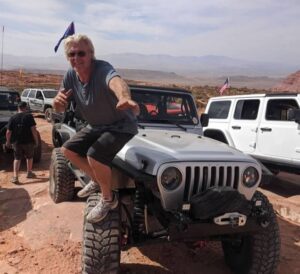 I lost one of my good friends in February to cancer. I knew Rob from our membership with FMCA 4 Wheelers, and had the pleasure of wheeling with him and his wife Toni all over the West.
You may not have known Rob personally, but he was the guy that was always first out of his Jeep when someone had trouble on the trail. His day was never finished, nor was it too early in the morning, when someone needed help getting their rig ready for the trail. He was the guy that welcomed new people and made them feel at home in our Chapter. You’ve probably met him, Rob was that guy!
Shortly after our last trip to Moab last year, he was diagnosed with Stage 4 cancer. He fought ferociously, and though he lost the fight, he was able to maintain his spirit and his love for wheeling and his friends through his last days.
Together, he and Toni made a decision to continue to make a difference with major donations to Cal4Wheel, BlueRibbon Coalition, and Utah Public Lands Alliance, organizations that work to preserve and protect our access to public lands. It is with great gratitude and appreciation we acknowledge their donation of $10,000 to Utah Public Lands Alliance to help in our fight to Keep Our Trails Open.
The OHV community lost a good friend this year, but his commitment and spirit will live on through all of us that knew him, and touch even those that did not.
Thank you Toni and Rob for your generous donation, and the everlasting memories.
Loren Campbell