A Second Chance for Reopening Closures in the San Rafael Swell and Desert

A Second Chance for Our Trails: Your Voice Is Needed Now For years, we’ve watched thousands of miles of roads and trails across Utah systematically closed through federal Travel Management Plans. Now, we have a real opportunity to push back—and reopen routes that should have never been taken from us.
A public comment period is now open for reconsideration of closed routes in the San Rafael Swell and San Rafael Desert where over 1,300 miles of routes were closed.This opportunity is the direct result of litigation led by the State of Utah and the BlueRibbon Coalition—supported financially by the Utah Public Lands Alliance (UPLA) and backed by persistent advocacy with the Administration.

And now—we need you.

What Trails are Open for reconsideration?

Trails in both the San Rafael Swell and San Rafael Desert are being reconsidered for reopening. Click on this link to go to BLM’s map tool where you can zoom in and see every route being reconsidered. If ones you have knowledge of, we need your comments.

Why This Matters

The San Rafael Swell and Desert Travel Management Plans closed over 1,300 miles of routes– These aren’t just lines on a map. They are:

  • Family traditions
  • Access to hunting and camping areas
  • Connections to remote landscapes
  • Economic lifelines for rural communities

Many of these closures included routes that were previously open and responsibly used for decades.

This upcoming comment period is our opportunity to put real-world grass roots comments with real voices back into the decision-making process.

What Happens Next

This reconsideration process follows the same path to the Gemini Bridges / Labyrinth Canyon review—where public input played a critical role in forcing agencies to take a second look.

At the same time, leadership from UPLA and the BlueRibbon Coalition will be in Washington, D.C., meeting with decision-makers across all branches of government.

We are pushing from every angle:

  • Administrative-BLM, Forest Service and the White House
  • Legislative
  • Legal

But none of it works without public engagement.

We Need Your Support in Two Critical Ways

1) Submit Detailed, Substantive Comments using our Easy Comment Tool

This is the most important thing you can do.

We need detailed, route-specific input—not form letters.

Use our New Comment Tool to Transform Your Answers into a Substantive Comment in just 2 minutes

BLM is required to respond to substantive comments—not general opinions. Our New Comment Tool will just ask you a few questions about your route and will transform it into a substantive comment that BLM must consider. It only takes a couple minutes to answer a few easy questions and you’ll get a comment that is ready to edit or post directly to BLM. If you have photos or gpx files, you can add those when you post to the BLM site.

Once you’re ready to submit your comments you can simply email them to BLM_UT_PR_comments@blm.gov

If you’ve ever said, “Someone should do something about this—this is your moment.

2) Help Fund the Fight

Litigation is what got us here—and it’s what will keep us in the fight. UPLA is raising another $50,000 to support BlueRibbon Coalition’s legal efforts to defend and reopen our access.

These cases are complex, time-intensive, and very expensive to pay teams or lawyers and lobbyists.

Every dollar goes directly toward:

  • Legal representation
  • Court challenges
  • Defending your access to public lands

Please give what you can to fund the fight!


All Donations of $75 or more will receive one of our new Safety Flags to display your support on your machine.
What Comes Next

We’re not stopping here.

The same effort is already underway to push for reconsideration of closures in the Henry Mountains Travel Management Plan.

This is how we win:

  • One plan at a time
  • One trail at a time
  • One voice at a time

Final Thought

Access isn’t lost all at once.
It’s lost quietly—route by route, decision by decision.
And it’s only restored when people show up.
👉 Show up. Speak up. Stand with us.

Together, we can protect—and reclaim—the access that belongs to all of us.

Sincerely,

Loren Campbell
Send email to President@UtahPLA.com with any comments or questions

Utah Public Lands Alliance
Defending Access • Preserving Freedom
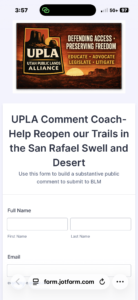


UPLA Launches New Comment Tool to Make Your Comments Substantive for the San Rafael Closure Reopening

Turn Your Trail Experience Into a Powerful Voice

       — In Minutes

If you’ve ever ridden a trail, camped with your family, or explored Utah’s backcountry, you already have something incredibly valuable: real-world experience.

And right now, that experience matters more than ever.

When the Bureau of Land Management (BLM) considers closing roads and trails, they are required by law to consider substantive public comments—not just opinions, but well-structured, experience-based input.

The problem?
Most people don’t know how to write a “substantive” comment.

That’s exactly why we built the UPLA Comment Coach.


A Tool Built for Real Trail Users

👉 Start here: https://form.jotform.com/261215118081043

Our Comment Coach—powered by Jotform—takes the guesswork out of the process.

Instead of staring at a blank screen wondering what to say, you simply:

  • Answer a few guided questions
  • Share your trail experience
  • Select from structured prompts
  • Add your personal observations

That’s it.


From Simple Notes → Substantive Comment

Behind the scenes, the tool organizes your responses into a format that aligns with what the BLM must legally consider.

When you’re done:

  • Your comment is automatically formatted correctly
  • It is structured to be substantive
  • It is emailed directly to you, ready to submit when the comment period opens

No writing skills required. No legal knowledge needed. You ;can edit the text or just copy and paste it to BLM or Forest Service.


What Makes a Comment “Substantive”?

A substantive comment:

  • Identifies a specific route or issue
  • Explains how and why you use it
  • Provides firsthand observations
  • Points out potential flaws in agency analysis
  • Offers a clear recommendation

That’s exactly what the Comment Coach helps you do—without you having to learn the rules.


Real Example from the Tool

Here’s what a completed comment looks like after using the Comment Coach to answer a few questions:


My name is Loren Campbell. I am a member of Utah Public Lands Alliance, BlueRibbon Coalition and I am submitting comments regarding the reconsideration of route Test346 in Both the San Rafael Swell and Desert. I use this route for UTV/OHV, 4×4, Camping access.  I used it once before to camp, and want to be able to go back.. 

This route is important because it connects to other trails, dispersed Camping or Overlook Trail. This trail connects to several others which is important not only for its scenic value, but also provides connectivity that can be crucial in an emergency on the trail. There is also a fantastic camping site with a great overlook that is no longer available without this route.

From my direct experience, I have observed that responsible use observed 

I believe the closure may be flawed and should be reconsidered because Impacts overstated.

I recommend that the BLM Reopen the Route. Please reopen this route, we need it.

I confirm that this is based on my personal experience and thank you for reconsidering this closure.

Respectfully,

Loren Campbell
Virgin, UT

That’s the difference.

Not just a comment—
A comment that must be considered.


Why This Matters Right Now

Across Utah and the West, thousands of miles of routes are being evaluated for closure.

If we don’t speak up effectively, decisions will be made without the benefit of real user experience.

So how much of a difference can it make? In the San Rafael Swell Travel Plan that closed 660 miles of routes, the State of Utah did a detailed analysis of the 5-6000 comments, no routes were closed that had 20 or more substantive public comments. Most roads that had 7 or more substantive comments unless they crossed a known archeological or paleontological site. If there were fewer than 4 substantive comments, the closure rate was high. Generally, the public commented both sparingly and very poorly on short routes that led to overlooks or dispersed campsites, resulting in many closures. Submitting substantive comments can make a huge difference, and if you can get friends that went with you on that ride to also write comments, it can lead to reopening the routes and dispersed camping.

Agencies rely heavily on their own data—but your on-the-ground knowledge is often missing unless you submit it.


Your Voice Carries More Weight Than You Think

You don’t need to be an expert.
You don’t need to write perfectly.

You just need to:

  • Share what you’ve seen
  • Explain how you use the trail
  • Submit your experience in a way that counts

The Comment Coach does the rest.


Take Action in 5 Minutes

👉 Use the UPLA Comment Coach now:
https://form.jotform.com/261215118081043


One Ride. One Form. Real Impact.

Every trail you ride is an opportunity to protect access.

With the UPLA Comment Coach, your experience becomes:

  • Organized
  • Credible
  • Legally relevant

And most importantly—impossible to ignore.

Loren Campbell
President, Utah Public Lands Alliance


Help Us Rescind the Minimization Criteria

At the heart of every land use decision affecting closure of our public lands to OHV, both with administrative agencies of BLM and Forest Service, and court decisions is the Minimization Criteria. This regulation became the backbone for nearly every modern Travel Management Plan (TMP), route designation decision, OHV closure decision, and litigation involving motorized access. The minimization criteria requires that BLM must locate OHV routes to minimize impacts to

1) Resource damage (including soils, watersheds, vegetation, air quality, and other public land resources-and to prevent impairment of wilderness suitability.

2) Wildlife impacts including wildlife harassment and habitat disruption, with special attention to endangered or threatened speciies.

3) User Conflicts between motorized users, nonmotorized recreation, and nearby populated areas, including noise considerations.

4) Protection of Special areas such as wilderness and primitive areas.

The rule was not established under FLPMA by Congress and was not even alluded to when it discussed the principal of the multiple use mandate and sustained yield. It was created by Executive Orders 11644 and 11989 under Presidents Nixon and Carter, and resulted in the adoption of CFR 8342.1.

In the final days of the last administration, Nada Culver, BLM’s Former Director, published a blistering BLM Policy Memorandum on the application of the Minimization Criteria directing BLM employees to strictly enforce a requirement that they minimize OHV impacts (use) in every land use decision. Culver included a precursor ruling on the WEMO case that is the subject of the current closure. UPLA and BlueRibbon Coalition have been working to get this rule rescinded ever since Culver published her Memo, along with the underlying 1970s era Executive Orders. (See our joint petition urging recission of the minimization criteria.)

The great news is that we’re getting very close to a positive result. Next month we have a meeting with a key policy analyst in Washington DC that is receptive to our request. What they have asked for us to bring to the meeting is evidence of public support for this action.


Rescind the Minimization Criteria